AI Hardware Investment at Risk as Network Fails to Keep Pace
New Onnec research finds rushed networking design decisions are delaying AI projects, restricting performance and creating costly problems after go-live.
London, UK – 10 September 2026 – New research from data centre infrastructure specialist Onnec has found that almost a third of operators (31%) have seen investment in high-performance AI hardware go to waste because the network connecting it couldn’t support it. This comes when demand for AI capacity keeps climbing, with 65% of operators seeing demand for AI capacity increase over the past 12 months, with the average estimated increase, among those reporting growth, at 44%.
“Everyone is focused on securing power and GPUs for AI, but the network connecting that hardware together is too often finalised only after those decisions have already been made,” comments Matt Salter, Global Head of Data Centres at Onnec. “The racks are set, the pathways are tight, and teams are left working around the design. You can have the power and GPUs in place, but they still need to communicate. If the network cannot support that traffic, the AI environment will not perform as expected.”
That’s already playing out, with 37% of operators having experienced latency, bottlenecks or other performance issues affecting AI training as a direct result. The study of 300 senior data centre decision-makers in the UK, Ireland and the Nordics also found 77% of operators say cabling is becoming a critical bottleneck to supporting AI workloads. Meanwhile, 41% say cabling always or frequently delays AI capacity projects. The knock-on effects are mounting:
- New AI capacity is becoming outdated as soon as it goes live: 83% say AI requirements are changing so quickly that new data centres need upgrades soon after go-live, and 37% struggle to future-proof their investment as those requirements shift. A further 33% have been unable to scale an AI environment without significant additional cabling work.
- Costly problems are surfacing after go-live: 44% have experienced costly remediation work or deployment delays caused by insufficient upfront cabling planning. A further 27% have suffered unplanned downtime caused by cabling failures, while 32% have reported a health and safety incident or near miss during rushed installation.
“We’re seeing data centres built that cannot support AI to the standard required,” explains Dr Inna Stelmukh, Group Director of IT and AI at Onnec. “Requirements are moving quickly, and infrastructure designed around the first deployment can fall behind just as fast. Europe needs more AI capacity, but capacity alone is not enough. If new facilities require constant upgrades after go-live, customers and investment will go elsewhere.”
Deadline pressure is reshaping network decisions
Much of this pressure traces back to how quickly cabling decisions get made, with 78% of operators compromising on cabling quality or specification to deploy AI infrastructure faster. The compromises stretch across design, procurement, installation and testing. Among those affected:
- 41% prioritised immediate needs over longer-term bandwidth requirements
- 41% spent insufficient time on cable pathway and capacity design
- 37% accepted available products rather than preferred suppliers
- 37% used less experienced contractors to move faster
- 33% reduced or skipped post-installation performance testing
“The priority is to make cabling part of the design before layouts and pathways are fixed,” adds Salter. “Operators need enough capacity, access and flexibility to support more than the first hardware deployment. Otherwise, today’s AI build-out will leave teams carrying out expensive work inside live facilities much sooner than expected.”
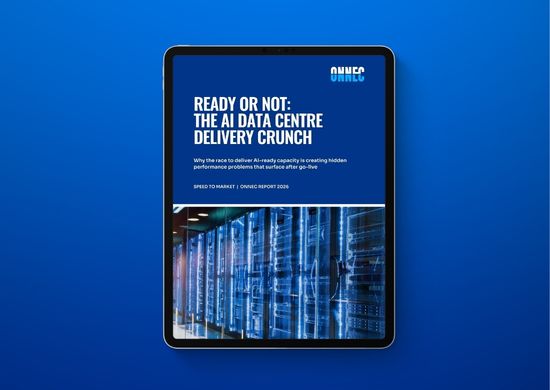
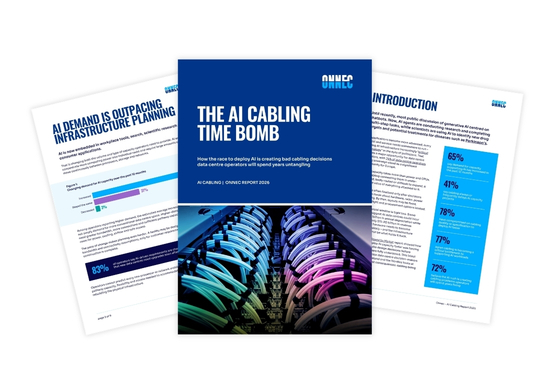
Download the free report below to discover how bringing cabling into the design process earlier can help identify constraints, reduce rework and ensure infrastructure is ready for more than the first deployment.
Methodology
The Onnec survey was conducted by Sapio between 27 May and 12 June 2026. It interviewed 300 senior decision-makers involved in the design, management and operation of facilities for data centre operators, including hyperscalers, cloud providers, enterprises and colocation providers.
Respondents were based in the UK (150), Ireland (50) and the Nordics (100). The survey was conducted online.
About Onnec
Onnec is a leading independent global IT infrastructure solutions and services partner, specialising in providing end-to-end connectivity solutions for data centre, office, fulfilment centre and other environments.
From structured cabling, managed services and networking, our end-to-end services give you the infrastructure you can completely rely on.
Onnec is one of the world’s leading exponents in this space and, with over 750 full-time employees across EMEA, US and APAC, the company is structured around key global customers to ensure consistency of service and delivery. As such, the company has a loyal customer base of leading businesses with many relationships spanning more than 30 years. Customers benefit from decades of experience and industry-leading standards – deployed at a local level.
Onnec is at the centre of connections, and strong connections are at the heart of everything Onnec does.