Stop treating APAC like a single data centre market
When people talk about global data centre expansion, APAC is usually one of the first regions they point to. Hyperscalers are scaling fast, AI workloads are driving unprecedented demand, and new capacity is being announced at pace. From the outside, it looks like a single, high-growth opportunity.
But that’s exactly where the problem starts.
APAC is not a unified market. It is a collection of vastly different operating environments, each with its own constraints, priorities and ways of working. Treating it as one region risks oversimplifying the realities of building and scaling data centre infrastructure – and ultimately, undermining delivery.
The problem is that this “regional” story breaks down the moment you look at how data centres are delivered.
One region, multiple build strategies
Nowhere is this more evident than in how data centres are being built.
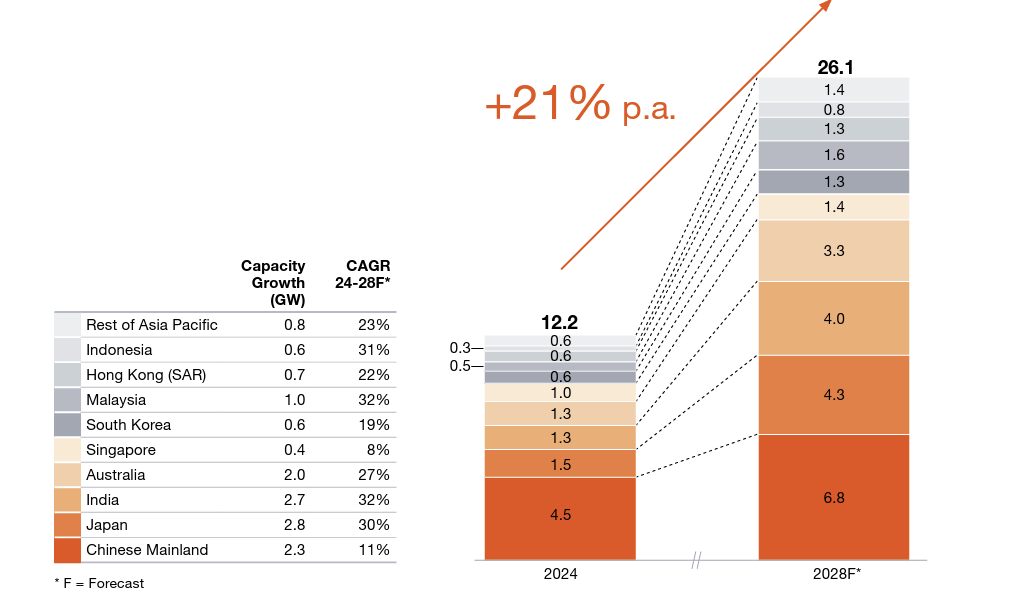
Take Singapore and Malaysia – two markets separated by little more than a short flight, yet fundamentally different. Singapore is a mature, highly constrained environment, where limited land and strict power regulations have made it challenging to build new data centres. As a result, capacity growth is projected to be among the slowest in Asia-Pacific, forecast at just 8% by 2028. Expansion remains possible, but tightly controlled, meaning most activity today is focused on retrofitting existing facilities rather than developing new ones.
By contrast, Malaysia is experiencing a boom in new-build activity. Hyperscale investment has accelerated rapidly in recent years, particularly in Johor and Kuala Lumpur. The availability of land and access to power has enabled large-scale developments, with demand showing little sign of slowing.
These are not marginal differences. They fundamentally shape how projects are planned, resourced and delivered. A strategy built for retrofit-heavy environments will not translate to high-volume greenfield construction, and vice versa.
And this is just one example. Across APAC, the conditions shaping data centre development vary significantly from country to country.
Power, policy and priorities vary by market
Beyond build strategy, the core drivers of data centre investment – power, land, connectivity and regulation – are far from consistent across the region.
Power availability remains the single biggest factor in determining where data centres can be developed. But it’s also about how that power is used. More compute means more heat. In hotter, more humid parts of APAC, cooling adds further strain to already constrained power resources.
How that power is accessed and regulated also differs widely by market. Singapore, for instance, has some of the most stringent sustainability requirements globally, with a commitment to net-zero emissions by 2050. Securing capacity is not just difficult – it is tightly controlled.
In contrast, markets such as Malaysia and Thailand are more open to investment, recognising the economic value data centres bring. This creates a more lenient environment for expansion, even if other constraints remain.
Australia presents another variation. It offers a highly capable technical ecosystem and strong infrastructure, but is also characterised by established players, mature supply chains and intense competition.
There is no single “APAC model” for data centre development. Each country represents a distinct set of trade-offs shaped by its economic priorities, regulatory frameworks and infrastructure realities.
The real challenge: people, pace and local ways of working
While much of the industry focus remains on power and cooling, one of the most consistent constraints on delivery is less visible: the ability to scale teams at pace.
Across key growth markets, such as Malaysia and Thailand, the speed and volume of development are placing pressure on available resources. Large data centre projects require hundreds of technicians on site, often operating around the clock to meet aggressive timelines. In many cases, capacity is committed before construction is complete, leaving little margin for delay.
The result is a delivery environment defined by urgency – where mobilising and coordinating teams becomes just as critical as engineering capability.
But this challenge is not just about numbers. It is also about how teams work.
Working practices, communication styles and operational norms vary across APAC. In some markets, established relationships and local business culture shape delivery. In others, language, geography or site conditions introduce additional complexity. Even in highly mature environments, competitive dynamics influence how quickly organisations can engage and scale.
Success, therefore, depends on more than technical design. It requires an understanding of local operating environments and the flexibility to adapt delivery models accordingly.


Why experience and the right partners matter
In such a fragmented landscape, applying a single strategy across APAC is unrealistic.
What’s needed instead is a model that combines global experience with local adaptability. This means deploying experienced teams to establish delivery standards, while working closely with in-region teams to scale effectively. Over time, this supports training and knowledge transfer, strengthens local capability and ensures quality is maintained as projects accelerate.
It also underlines the importance of working with partners who understand both sides of that equation.
Partners with global delivery experience bring proven methodologies, quality assurance and the ability to operate at pace. At the same time, those with a strong regional presence – or the ability to build one – can navigate local complexities, from regulatory requirements to workforce dynamics and cultural nuance.
As timelines compress and expectations rise, that combination is becoming essential to delivering successfully at scale.
Rethinking how we talk about APAC
The data centre opportunity in APAC is significant. But it cannot be understood, or executed against, through a single regional lens.
From Singapore’s constrained, sustainability-driven model to Malaysia’s rapid expansion, each country presents a different set of challenges and opportunities. The operators that succeed will be those that recognise this complexity – and utilise expert partners that can help them to adapt accordingly.
Because the question is no longer how to scale in APAC as a whole, but how to navigate a region where no two markets are the same.