Europe wants sovereign cloud – but now it needs somewhere to put it
For a long time, sovereign cloud sounded like something for policymakers, procurement teams and compliance specialists. Important, yes. Urgent? Not always.
That is changing quickly.
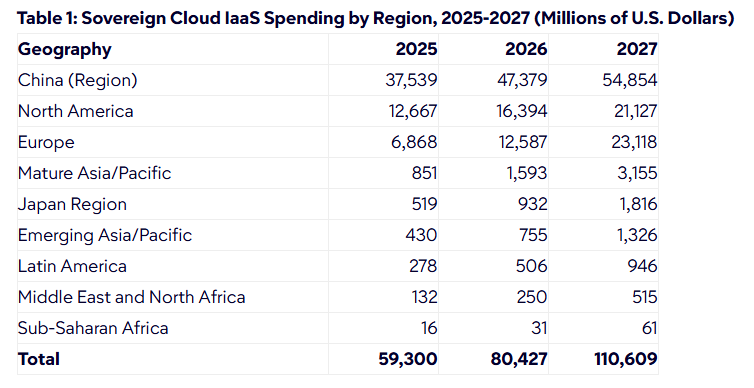
Recent restrictions on access to advanced AI models have shown how quickly access to critical technology can shift when capability sits outside an organisation’s, or a region’s, control. At the same time, sovereign cloud spending is accelerating across Europe. Gartner forecasts that European sovereign IaaS spending will rise 83% in 2026, from $6.9 billion to $12.6 billion.
Sovereignty is no longer just about where data is stored. It is about who controls the infrastructure, platforms and AI capabilities organisations depend on. Can critical workloads stay within trusted environments? Can governments and enterprises reduce exposure to changing rules, providers or geopolitical pressure? And if Europe wants to build more sovereign cloud and AI capability, does it have the data centre infrastructure to support it?
Sovereignty is becoming a buying decision
Sovereign cloud is moving from policy debate to procurement reality. The European Commission has awarded sovereign cloud contracts for EU institutions, meanwhile, cloud leaders have warned against “sovereignty washing” ahead of the Cloud and AI Development Act (CADA).
In practice, sovereignty depends on control, not just branding, location or compliance language. A service may look European on the surface, but if ownership, operations, legal exposure or technical dependencies still sit elsewhere, the dependency remains.
This is becoming even more important as sovereign cloud and sovereign AI converge. AI models, data, inference, storage and compute do not exist in isolation. They depend on the physical environments beneath them: data centres, power, cooling, cabling, connectivity and skilled operational teams.
Demand is there – but can Europe deliver it?
The demand for sovereignty is creating a major opening for data centre operators. Onnec’s latest research found that 74% believe sovereign cloud represents a significant opportunity for European operators over the next three years.
That optimism is understandable. Governments are putting more money behind sovereign AI, from domestic AI companies to hardware start-ups and research labs. Enterprises are also reassessing where critical workloads sit and how much control they have over the platforms that support them. But ambition needs infrastructure behind it.
Sovereign cloud requires data centre capacity. Sovereign AI requires even more. It needs high-density environments that can support demanding compute workloads, resilient networks, robust physical security, specialist cabling, cooling and the teams needed to design, install and maintain that infrastructure.
CADA aims to triple Europe’s data centre capacity over the next five to seven years but the sector is already under strain. Power availability, planning delays, rising build costs, supply chain pressure and skills shortages are slowing projects before sovereign cloud and AI demand is even fully felt.
New builds will not solve this alone
It is tempting to think the answer is simply to build more. More campuses. More capacity. More high-density environments.
New capacity will be essential, but it will not appear overnight. It has to be planned, powered, approved, built and connected. If Europe waits for every new-build project to come online, the infrastructure needed for sovereign cloud and AI could lag behind demand.
That is where retrofitting becomes critical. Many existing facilities were not designed for the density, resilience and cooling demands now being placed on them by cloud and AI workloads. Upgrading those environments can help unlock capacity faster, extend facility life and improve resilience.
But live data centres are not blank canvases. They cannot simply be switched off and rebuilt. Power, cooling, cabling and network design all need to be planned around environments where downtime is not an option.
The right partner matters
Sovereign cloud will only scale if the infrastructure beneath it is ready. Operators need to understand where existing sites can support denser workloads, where power, cooling, cabling or network constraints will appear, and how upgrades can be delivered without disrupting live operations.
This is where Onnec supports operators. Its teams work across the physical infrastructure layer of data centres, from structured cabling and network design to deployment, upgrades and live-site remediation. That gives operators the practical support needed to assess what existing facilities can handle, identify where infrastructure needs to be strengthened, and deliver upgrades safely without disrupting critical operations.
As sovereign cloud and AI demand grows, operators will need infrastructure partners that can help them move quickly without building in problems for later. The challenge is not only bringing more capacity online, but ensuring that capacity is secure, resilient, scalable and ready for the workloads Europe wants to keep within trusted control.
Europe may want sovereign cloud. It may increasingly need sovereign AI. But its success will be decided in the data centre.